Showing posts with label Invasive Plants. Show all posts

Saturday, October 26, 2013

Vegetable Garden Review 2013

The weather's good and cold and all the plants have withered.


Must mean it's time to do my yearly review of the veggie plot.

Let's start with the bad things and end on a high note, shall we?

The biggest tragedy by far this year was the perennial plants.

My strawberries had to be dug up
Asparagus, rhubarb and strawberries were all a bust.   A complete and total bust.  I did not collect one single asparagus spear this year.  That's because sheep sorrel took over.  This invasive plant has to be removed out of the veggie garden on an almost daily basis.  There's no escaping it as it's everywhere on our property and it spreads like wildfire.  The majority of the annual vegetable beds get dug out at least once or twice a year which helps combat the problem but I can't do this with perennials.  I simply don't have the time to weed them consistently and the result is all these plants have been choked out.  You can see in the above photo, on the left there's more weeds than strawberries.  I had to completely dig out the entire bed and start over.

I am working on a plan though.  I have begun, in a very small way, to eradicate the grass and weeds in the paths of the veggie garden.


I started laying down layers of newspaper and cardboard in the spring.  (I knew those flyers were good for something!)  I followed that with a 3 inch thick layer of sawdust.  Then straw.  The hope is that I end up killing the weeds underneath so they stop sneaking into the veggie beds.  The small sections I was able to complete did well so I hope to continue with this next year.

The next tragedy feels minor in comparison.  I discovered that spinach seed doesn't last very long.  3 years in fact.  I should have known that, but now I won't forget.  I planted my spinach and waited, and waited, and waited. Thank goodness I was paying attention and got myself to a store to buy fresh seed. Unfortunately the weather was getting a bit warm by that point and I didn't have great germination.  So a less than stellar crop of spinach but now I know better.

Another problem with germination was beans.  I was in a hurry and just couldn't wait for the weather to warm up.  So into the ground they went and it rained and rained.  My poor beans rotted.  

Dragon's Tongue on the left and Purple Peacock on the right
I did manage to get a couple plants to come up but it was a pretty lean year for beans.

Thankfully, the tragedies aren't life or death.  Every year has surprises, and some of them are good.  What we lacked in beans we more than made up for in peas.


I had very good germination rates this year, followed by tons of blooms and bees, which resulted in LOADS of peas.  I think I spent most of my summer picking peas.  Every second day starting in June straight through August I picked peas.  August?  yes, August.  The plants had almost stopped producing in July but then we had a spell of rain.  And the vines grew, and bloomed some more, and then there I was in August still picking peas.  Good thing I like peas.  They're an awful lot of work.

Another great surprise was onions.


You know, the fact that I was actually able to grow some.  For 3 years I have been trying to grow onions with no luck.  They rotted, they withered, they refused to grow larger than a marble.  Through a combination of starting seed early, improving my soil, and not burying the plants too deeply I was finally able to produce some proper onions.  Every time I visited the garden this year I did a happy dance around the onions.  I grew those!!

As noted in my previous post I finally managed to grow pumpkins this year too.

My pumpkin patch
Whatever issues I was having last year are gone.  Good thing we have some space.  There's a manure pile under those vines somewhere.  Our weedy meadow was no match for these plants.


Aren't they the most beautiful pumpkins you've every seen?!  BIG big thanks to Brenda @ Gardeningbren for gifting me with the seed for these Long Island Cheese pumpkins.  The whole neighbourhood is enjoying the proceeds of this crop.

That's a wrap for 2013.  This was our fourth year gardening here on the Corner and it was the best yet. For those of you dying to know what happened to the tomatoes.... you'll have to wait.  I grew approximately 25 plants this year so they get their own post.

just another beautiful day in the garden
till then....

Saturday, November 24, 2012

2012 Vegetable Garden Review - The Tragedies

Vegetable gardens consist of mainly annual plants which we harvest or pull out at the end of each season.  This is a fantastic opportunity to start fresh each year.  I learn from the previous years problems and plan on changes for the season ahead.

The weather is finally taking a turn for proper cold this week and it's time I took a look back at the 2012 gardening season.

Late frosts killed some early seedlings
Overall I really don't have any major complaints this year.  After 3 years of expansion the space I have cultivated is quite substantial and I'm able to grow most everything I want.  However, I'm still working on getting the soil to a point where it's nutrient rich enough to support heavy feeding vegetable crops.  In one particular bed I added bonemeal, bloodmeal, lime, manure and compost.  After a lot of work that bed finally produced a decent crop of spinach.  But that kind of work needs to be done to every bed.  Something I haven't yet accomplished.

This resulted in yet another poor year for beets and rutabagas.

Cuttings from a rutabaga with brown heart
My beets continually germinate and then refuse to grow.  I'm lucky to get more than 4 or 5 beets every year.  Rutabagas grew but were continually bothered by cabbage caterpillars and when I finally got a look at the roots they were riddled with brown heart.

Good soil promotes healthy plants so before anything else I need to keep working on that soil so that my plants are better able to fend off pest attacks.

Another issue this year has been weeds.  I have a real problem with sheep sorrel on my property.


This perennial weed spreads very aggressively via rhizomes and I have a really hard time keeping it out the veggie beds.  Even the raised beds are no match for this beast.  I really don't have an answer to how to deal with this.  Short of spraying all three acres with Round Up (which is not going to happen) perennial weeds are here to stay.

A big issue in spring was poor germination.  It seemed to be a combination of bad seed and bad conditions.  We had so little rain throughout the spring and summer and although I did water I don't think it was enough.  The result was a handful of stunted parsley plants, a dozen carrots, and a pretty gappy looking row of peas.  I will be throwing out a number of seed packets and starting fresh next season and remembering to water well those first weeks seeds get planted out.

There were supposed to be peas in that bed
My last big issue this season was onions.  Some days I question my sanity when it comes to onions.  I have never grown a satisfactory onion and yet every year I try to no avail.  If anyone out there has some advice with regard to onions I would be forever grateful.  I have tried seed and I have tried sets.  I have tried different varieties in raised beds and in the ground.  Each year the plants grow a few inches and then suddenly shrivel up and die.  Is this another issue with my soil or is there something else going on here?  One day I hope to solve the puzzle.

Thursday, September 8, 2011

A Walk Through the Meadow

Since we're touring the garden we can't leave out the meadow can we?  The grasses have long since dried and spring flowers have changed to fall.  In the last week the asters started to bloom.


The large flowered white aster with the yellow button


The tiny white Aster lateriflorus or Calico Aster with its horizontal branches and pink buttons changing to yellow.


And the large purple asters.  They flower with such abundance and everywhere I look there's another plant.   How lucky we are that this lawn turned meadow should be so full of this quietly beautiful flower.

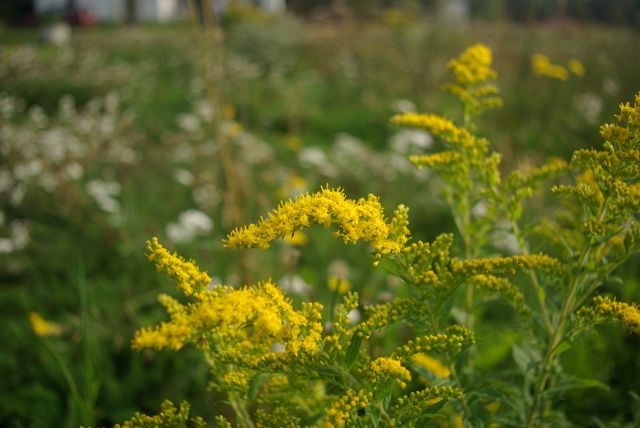
Also flowering in abundance is goldenrod.  Last year there was not a single plant in the meadow and I wondered how that could be since the hedgerow is full of goldenrod.  Perhaps the plants just needed an extra year to grow as they are showing up in great numbers now.


Another plant I don't recall seeing last year in the field is this funny plant.  This year it is turning up everywhere on the property it seems.  I suspect it is Hemp Nettle, a weed introduced from Europe.


Although I noticed this next plant last year it seems to have covered more ground this year.


Common toadflax is another invasion from Europe, brought in as an ornamental plant.

I have really struggled to identify this next bloom.  I found a group of them hidden in a shaded patch tucked between my neighbours hedge and the roadside.   


They appear to be a double flower and are quite pretty.  Does anyone have ideas about what it might be?


As it happens I discovered this bloom's identity is while looking for something else!  It is an ornamental plant from Europe, traditionally used in cottage gardens.  Saponaria officinalis is often called Bouncing Bet.  This particular flower is a double form called Rosea plena.

In that same secluded corner is my native Witch Hazel, Hamamelis virginiana.  This plant has grown by leaps and bounds since being planted last spring and is beginning to put out tiny yellow flowers now this fall.


And what would a trip into the meadow be if I didn't show you the progress of my little red oak?


I simply cannot believe how much this tree has grown this year.  It is close to the size it was when we first bought it last spring.  After being gnawed to bits by voles this past winter all that you see here is brand new growth.  That's several feet of new growth in one season.  Truly truly astounding.

Tuesday, September 6, 2011

What's That Behind the Garage? A Fairy Hobmother!

Let's continue the tour around the gardens shall we?  Lurking on the far side of the garage is my favourite project of the year.  Possibly because it's one of the few things that was completed!  Last fall I put down newspaper and compost to create a new bed behind the garage.  This spring I decided it wasn't quite large enough and used the sod cutter to widen it just a bit as well as lengthen it. 

I wanted to make sure the bed was wide enough to contain the plants once they had grown to full size
I wanted this bed particularly for a plant I had bought at last year's plant sale.  The Plume Poppy is an excessively large plant that has invasive tendencies and I thought putting it in its own bed might help to contain it.  Once the bed was created I dug the poppy out of its place in the entrance bed and brought it over.  It has done well to say the least.

It took no time for this plant to grow several feet high and wide
Prior to Hurricane Irene the Plume Poppy was approximately 6 feet tall with sprays of tiny white flowers adorning its tops.

Days before the storm
Unfortunately this plant cannot handle wind.  Despite the thick stalks, the plants were pushed over in the wind gusts and even uprooted.  The bed doesn't look quite as good now but since this plant is such a rampant grower I think it will grow back in the spring just fine.

In addition to the poppy I planted hollyhock seeds from my mother's garden.  They are a single red variety that I hope will complement the leaves of the Plume Poppy.  I seeded them pretty thickly and they have formed a carpet of plants now one foot high.  

In keeping with a theme of large leaved plants I moved a large hosta from the front of the house and divided it into three plants.  I was shocked at how quickly the divisions grew.  Each division is now almost the size of the original plant! 

The hostas in this picture were divisions of just one plant!
Other additions from nursery shopping excursions included Heuchera sanguinea 'Ruby Bells'


Columbine 'Winky Purple-White' (Aquilegia vulgaris), Speedwell 'Blue Bouquet' (Veronica spicata)  and Hardy Geranium 'Samobor' (Geranium phaeum).

When I expanded the bed in spring I went right around to the back of the garage.  Here I placed Lily of the Valley and the mystery corm.  I thought the corm was a tropical plant and would like the heat.  Surprise!  A dear relative was able to identify this plant for me and hot is NOT what this plant was looking for.

The leaves finally opened!
Turns out this corm is actually a native plant called Jack in the Pulpit or Arisaema triphyllum.  A plant that thrives in woodlands and part shade.  Little wonder it was struggling with the hot and dry conditions on this side of the garage.  A change of location is definitely in order.

Plants that are liking the hot and dry conditions are Echinacea purpurea 'Powwow White' and Rudbeckia laciniata 'Golden Glow'.  The Echinacea was only recently planted but the Golden Glow has had all summer to get comfortable and it appears quite happy.  I love coming round the corner and seeing the cheery bobbing yellow faces.


But what about the Fairy Hobmother you say?  Even if you look closely she is hard to spot but if you ask nicely perhaps she'll visit you personally.  Last week I was traipsing around the blogosphere visiting Jen at Muddy Boot Dreams.  Jen mentioned a Fairy Hobmother had been to see her and maybe the Fairy from Appliances Online would visit me too if I left a comment.  Well, what a surprise.  This Monday morning I opened my mail to discover the Fairy Hobmother had come to visit.  New plant markers will be on their way to me by days end!  Would you like the Fairy Hobmother to leave you a present too?  Please leave a comment below and you might be the next lucky recipient of her magical ways.

Thursday, November 18, 2010

The War Against Bindweed

When you purchase a new home there is only so much time to take in the details of the house and property.  The aspects you love will jump out at you and probably a few things that need fixing.  But there are many things that you don't notice at all.  And I definitely didn't notice that bindweed was thriving all around our property.

I've seen bindweed before but I've never had a problem with it in my garden.  Well, it seems my time has come.  For those of you who aren't familiar, let me introduce you to Bindweed, or Convolvulus.  Bindweed has a couple of forms including Field Bindweed and Hedge Bindweed.  For all intents and purposes they are essentially the same thing, with one being slightly larger than the other.  Bindweed is a perennial vine closely resembling a morning glory.  The plants creep along the ground pulling themselves up any plant that will support them, sending twining stems around and around.  Eventually they form dense mats around other plants that choke and suffocate them to their demise.  The flowers tend to be white or pink and the leaves are triangular or arrow shaped.
Bindweed blooms look like morning glory and have distinctive arrow shaped leaves.
This invasive weed was introduced from Europe and has spread rapidly throughout North America.  It spreads via long lasting seeds that can remain dormant for up to 20 years and also by thick rhizomes.  The rhizomes contain buds along their length that can turn into shoots when they break away from the main root.  Bindweed rhizomes are extremely brittle and break easily so it can be a tricky situation as each portion of the root that is broken away can transform itself into a whole new plant.

I'm not a big weeder by nature.  I love all plants and often weeds are extremely beneficial to insects and other wildlife.  I'm also lazy.  So weeds tend to be a normal part of my garden.  But in this case I'm seriously against bindweed.  It is incredibly destructive to other plants, forming great mats and preventing air and sunlight from penetrating the plants laying underneath this vine.  Recently I've been even more rattled by the fact that this insufferable beast of a weed is trying to make itself at home in my compost bin.  The bin is located next to the hedgerow, which I didn't realize until too late, has bindweed growing though it.  Over the course of the summer the bindweed tried to cross from the hedge and twine itself around my bin.  Frustrated I cut a one foot swath around the bin and I regularly go in and pull the vine to thwart its attempts to make itself at home.

But I hadn't thought about the fact that bindweed spreads by roots.  Recently we've had a spell of warmish weather and I decided to work at cleaning up a compost pile started last winter.  It's in the same location as my compost bin, next to the hedge.  And over the course of the summer the weeds have practically been jumping out of the hedgerow and clambering onto that luscious compost.  That includes the bindweed which I've been hand pulling off the top of the pile.  So I began the work scooping up this compost and placing it in beds when to my horror I found this.


As I dug through the pile I began to find huge pieces of bindweed roots.  Not only had the plant tried to jump on top of the pile but it also sent its roots out underneath it.  There's a mass of roots hiding in my compost pile!  The pile has been a slow compost and not hot so the roots have survived quite happily there.  Although frankly I wouldn't even trust bindweed in a hot compost.  This stuff is just too prolific to take a chance.  Now some people might have said to heck with it and abandoned the compost but it's a prescious commodity around here and the fact is that no matter where I put the compost the bindweed will go with it.  The best course is to remove the offending plant and its roots.  So I've been spending rather copious amounts of time lately sifting compost, shovelful by shovelful, and pulling out the roots of bindweed as I go. 

The good news is that the roots are pretty hard to miss.  Once you've seen them you'll always know.  They can get to be as thick as a pencil and are a bright white.  Their most distinguishing characteristic has got to be how brittle they are.  They snap instead of bending.  Of course this means you have to be careful to not break them and be very very careful to pick out each and every piece.  I think I did a pretty good job of sifting but I'll be keeping a close eye on my compost in spring to see if any plants spring up.

 The above pile of roots has been placed in a brown bag in the garage where they will dry out over the winter and hopefully die before being taken off to the garbage where they belong.

Thursday, August 26, 2010

Wildflower Wednesday

Yes, I know it's Thursday.

I tried to do a wildflower post yesterday but when I looked up the plant I intended to feature I got muddled and my post began to morph into another "Is this a Wildflower or a Weed" struggle.  It seems I'm having a lot of problems with that concept these days.  I think I'm trying to define a rule that says this is a weed or this isn't a weed.  But life is not black and white, just infinite shades of gray and a wildflower (or weed) will not be hemmed in by rules.

So instead I'm joining the Wildflower meme today, courtesy of Clay and Limestone, and showing off some plain old field plants.  I'm not looking them up, not questioning their parentage, and not debating their weediness.  I'm going to appreciate them simply for their looks and their willingness to grace my former lawn with their presence.
violets
thistle


You can just make out the vestiges of our former lawn under the carpet of tall dried grasses.

Clove and yarrow are beginning to fade and dry out in the hot August sun.
Something in the legume family

Climbing nightshade
Witch hazel
There, that wasn't so hard.  Much more interesting than the plain old lawn that was there before.

Friday, August 20, 2010

Triumphs and Tragedies

Another holiday day this Friday, although this time it's courtesy of the Province of PEI.  Instead of a long weekend at the beginning of August we take a holiday in the middle of the month to celebrate The Gold Cup & Saucer.  That's right.  We are celebrating a horse race.  (Gotta love these islanders!)  And the end of summer.  *sigh*

Anyway, I took a little tour of the garden this morning and have been watering non-stop since then.  Despite having rain showers throughout the last month there hasn't been a good soaking so some plants are looking a little wilty and bug damaged.
Highbush cranberry is rather spotty
Other plants don't seem bothered by the heat at all.  I'm not sure if this is such a good thing.  For instance, do you remember the Plume Poppy I sort of accidentally purchased in the spring?  I thought it was an actual poppy and didn't realize it's invasive nature.  Well look at it now.
That's it in the foreground.  Already about half the size of the apple tree behind it.  A little triumph and tragedy all mixed in one package.  It's doing so well but when does it decide to move into the house and evict us?

A very exciting triumph for me is the status of the vegetable garden.  It has gone from looking all vegetablelly to pretty.
My zinnias have started to bloom and the cilantro has decided to follow suit.  Not that I don't like vegetables but they often look so drab.  Some bright colours go a long way to making my vegetable garden a delight to the eyes as well as the senses.
Did I really put pink and red together?  oh ya!
And a final triumph for the day.  I saw these sedums pop up in the spring but really haven't paid them any mind till now.  In the past I've had a variety called Autumn Joy which frankly didn't set my bells to tinkling.  Kind of ho hum pink eventually darkening to a more cherry then russet colour.  I assumed, incorrectly, these would be the same.
Not so.  They came out with a bang in a very extreme pink almost purple colour.  I like these a lot better.

Well that's it for the day, Happy Friday everyone.

Monday, August 2, 2010

A Bicycle Trip in the Country

One of the many benefits to living on Prince Edward Island is the Confederation Trail.  This trail is the former rail line which ran from one end of PEI to the other.  Abandoned in 1989 the 357 kilometres of track was converted to a walking and cycling trail.  The wide riding area is covered in rolled stone dust making for an easy riding surface.  This is one of those times when I don't miss mountains.  The distinct lack of large hills makes riding a pleasant and easy way to spend the day outside.
Because the trail stretches from one end of the province to the other you are able to see all sorts of different landscapes.  Tree lined forests to hay fields and salt marshes.
This is also a great way to discover native plants.  As you bike along you'll see many examples of native trees and shrubs along the way.  I'm hoping the 3 white pine I planted in the spring will one day be as lovely as this larger specimen.
Along with the varied landscape comes many plants that I don't have in my own yard such as cattails or Typha latifolia. (Although I do have cat tails of a different variety, mine actually have cats attached)
This wild Liatris was found blooming alongside the cattails.
Jean tells me this is more likely Purple Loosestrife, an incredibly invasive weed.  After checking the photos and descriptions of loosestrife unfortunately I have to agree.
What a shame I don't have these in my yard either.  The trail was lined with wild blueberries and I had to stop and eat my fill before we could move on.
Other plants in bloom along the way included this wild rose or Rosa carolina.
Queen Anne's Lace or Daucus carota

Rudbeckia hirta
and Fireweed or Epilobium angustifolium